Upalgo Labeling DAS
Distributed acoustic sensing data labeling
Upalgo Labeling DAS is the edition of Upalgo for distributed acoustic sensing. It reads interrogator acquisitions in their native format, displays the fibre as a time-distance waterfall, and supports labeling in time and along the cable, with the tools and team workflow of Upalgo Labeling Sound.
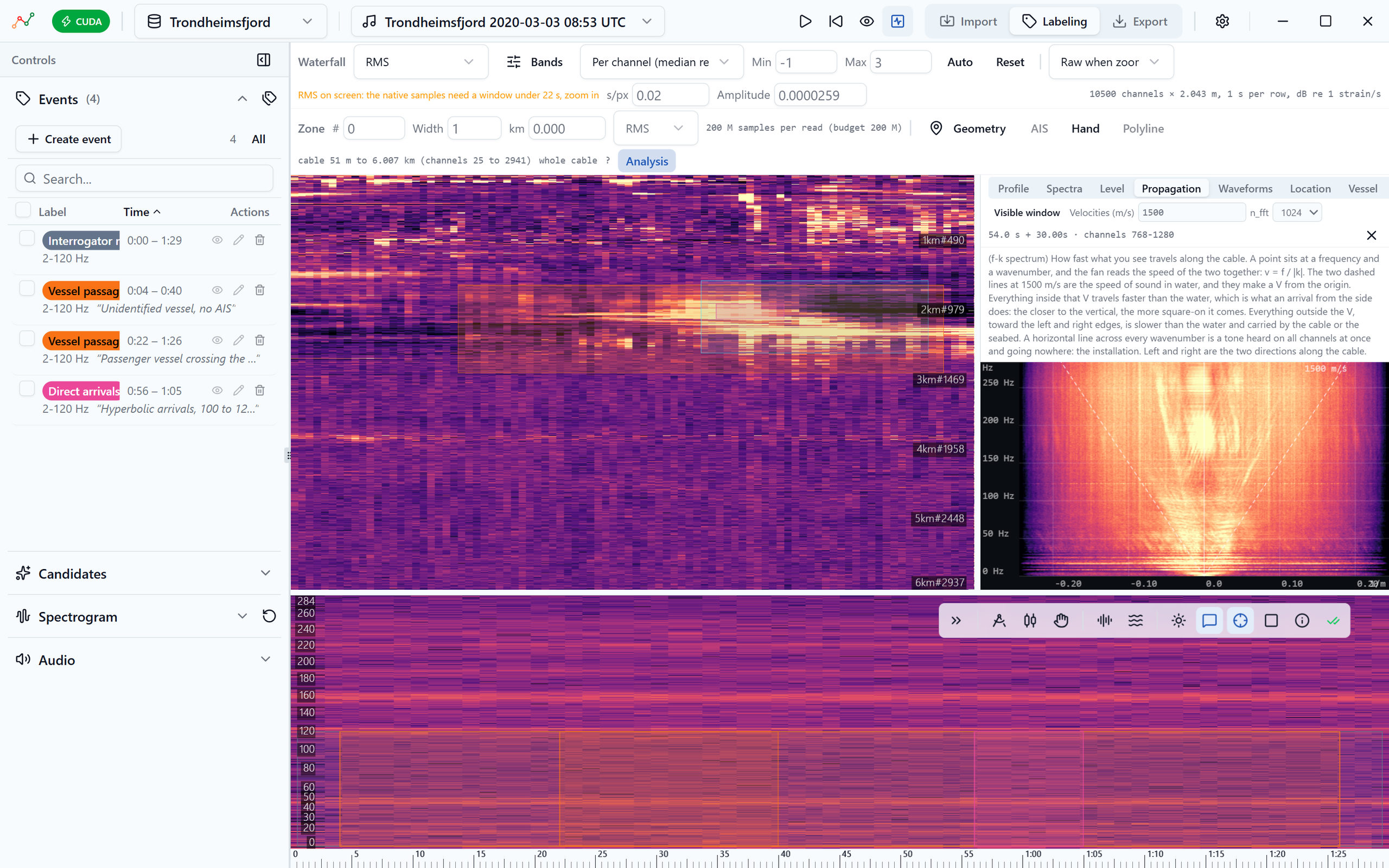
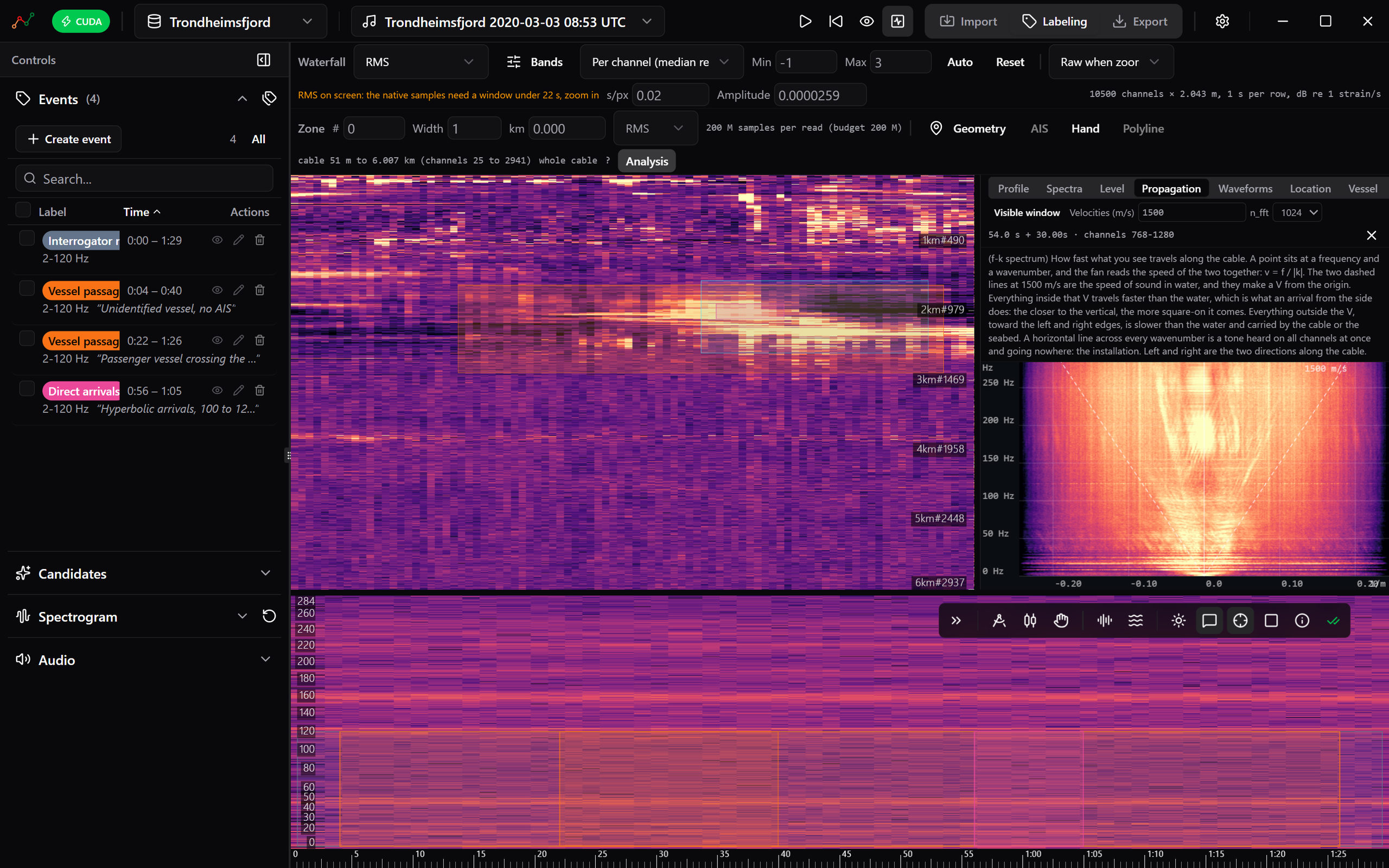
- The events of the acquisition, each with its class, its time window and its band.
- A vessel passage labeled on the waterfall: time across, distance along the cable down.
- The frequency–wavenumber spectrum of the selected window, with the lines of the speed of sound in water.
- The spectrogram of one channel, where the same event is boxed in frequency.
Capabilities
Native formats
DAS files read as produced by the interrogator; multi-file acquisitions; metadata compliant with the FDSN DAS standard.
Operator displays
RMS waterfall with raw phase at high zoom; RMS and spectrum versus channel; power spectral density in physical units; multi-band energy false-colour composite; wiggle traces; f-k spectrum.
Channel listening
Listen to any channel or section of the fiber while viewing its spectrogram below the waterfall on a shared time axis.
Spatio-temporal labeling
Events defined as time-channel boxes or as tracks following a moving source; positions exported in channels and metres, in JSONL and CSV.
Vessel tracking
With the cable geometry, AIS positions are projected onto the fibre. Vessel passage, speed and position are estimated from the acoustic signature.
Customer processing
Python scripts run on the selected data. Outputs are overlaid on the waterfall and detections become events for validation.
Maritime and terrestrial
Configurations for vessel traffic, marine biology and perimeter intrusion detection, or defined by the customer.
Built for large-scale DAS data
DAS produces large volumes of spatially distributed signal data. Upalgo Labeling DAS provides synchronized views so analysts can move from a broad acquisition overview to detailed signal analysis and event labeling.
See what Ezako can do with your data
Describe your signals and your requirements to arrange a demonstration.