Why anomaly detection matters to companies
Anomaly detection finds the unusual patterns in a company’s data before they become serious problems: what it is used for, and why it matters.
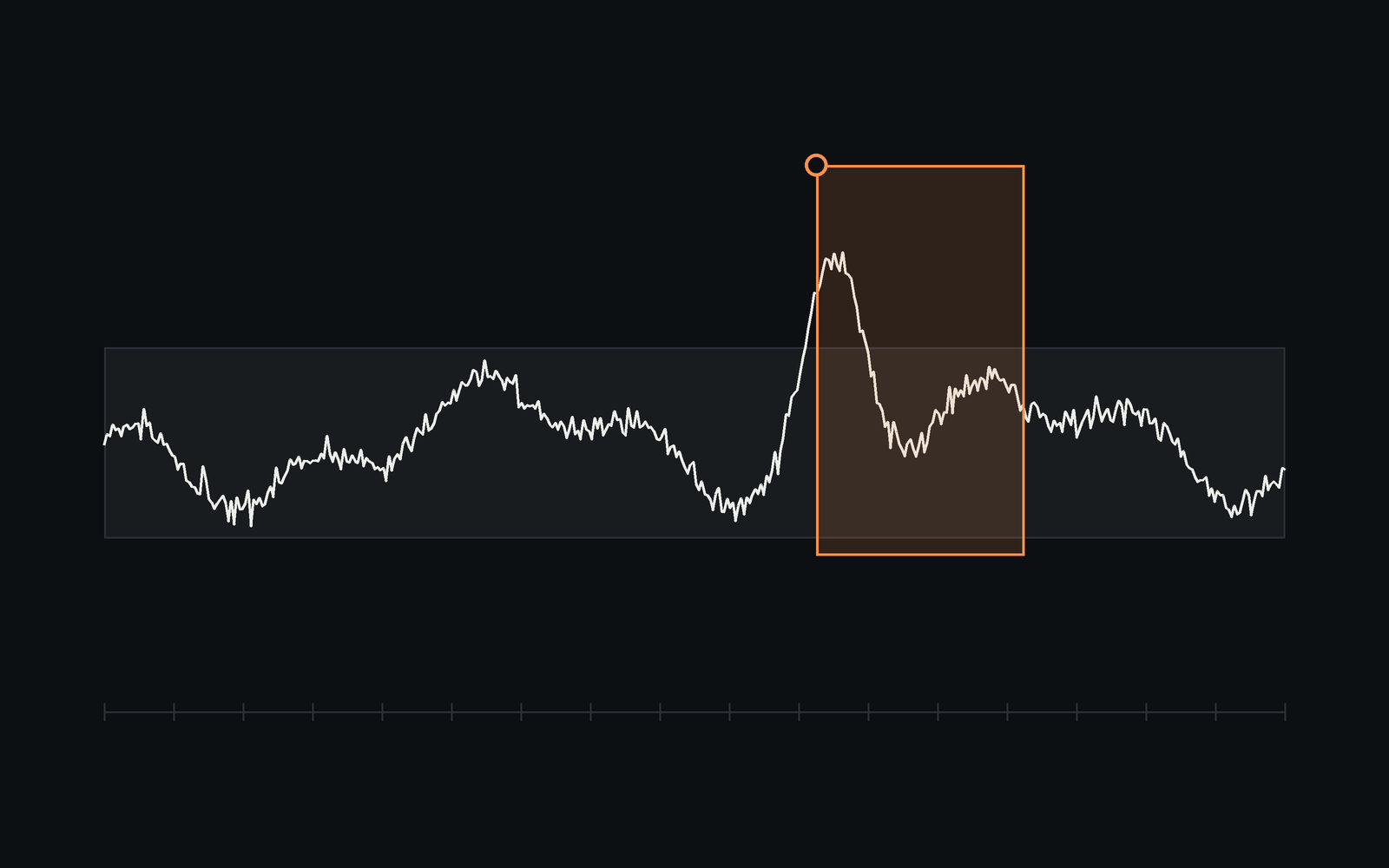
Anomaly detection finds the observations in a stream of data that do not behave as the rest: the vibration that changes shape before a bearing fails, the telemetry channel that drifts, the vessel that passes where none should. It matters because the rare event is the costly one, and because no team can watch thousands of series by eye. Whether it pays depends on two things the method itself does not settle: how the anomalies are defined, and how many false alarms the operation can absorb.
Three kinds of anomalies
The survey by Chandola, Banerjee and Kumar (2009) distinguishes them by what makes the observation abnormal.
| Kind | What is abnormal | On a signal |
|---|---|---|
| Point | One value, out of range on its own | A spike in a pressure series |
| Contextual | A value normal elsewhere, abnormal here | A current normal at full load, abnormal at idle |
| Collective | A sequence, each value normal, the pattern not | A vibration that keeps its level and changes its spectrum |
A fixed threshold catches the first kind. The other two need the context, the neighbouring channels or the shape of the sequence, which is what a model learns from examples.
Why it matters, with the cases behind it
- Equipment under test. On an engine test bench, abnormal observations in the high-frequency sensor series can make whole spectrograms unusable; detecting and correcting them is what keeps the test's information. Ezako published a deep learning approach to this with Safran Aircraft Engines in 2021.
- Operations at scale. ANFR oversees more than 76,000 radio sites in France. In 2020, Ezako predicted which sites were most likely to reveal an anomaly, so that inspections could be ordered by likelihood rather than by list.
- Systems that cannot be visited. A satellite is monitored through its telemetry alone. In 2020, CNES entrusted Ezako with anomaly detection on it, alongside the conventional surveillance methods, which it does not replace.
- Embedded constraints. Within the DeepGreen project led by CEA (2023), the detection had to run on a microcontroller: the model is judged on its size and its energy as much as on its recall.
- Surveillance at sea. On hydrophone and fibre recordings, the anomaly is a vessel passage, an unusual signature, a source not seen before. The RAPID DASMIA projects with Alseamar (2022) and XPERT (2025), supported by the DGA and the Agence de l'innovation de défense, work on detecting them in real time on the platforms themselves.
What decides whether it pays
| Fixed thresholds | Learned detection | |
|---|---|---|
| Catches | Point anomalies | Point, contextual and collective anomalies |
| Needs | An engineer's limits per channel | Labeled examples, reviewed |
| False alarms | Many when conditions change | Set by an operating point, measured in alarms per hour |
| Unknown faults | Missed unless they cross a limit | Found when they depart from the learned normal |
| Maintenance | Limits revised by hand | Dataset versioned, model retrained on validated detections |
The line that matters is the false alarms. A detector that flags ten events an hour for an analyst to dismiss is switched off within a month; the operating point is chosen on a validation set for the precision the operation can live with, and the recall is what that precision allows. Every detection is then validated or rejected by a person, and each decision is a new label: the detector improves on the customer's own data, and the count of false alarms is measured, not assumed.
Where to start
- Name the anomalies that cost something, with the people who run the equipment.
- Label a first sample of recordings and review it.
- Measure a first detector on held-out data, at the operating point the operation needs.
- Put it in service with human validation, and version the dataset as the labels grow.
The algorithms, sensor data analysis and underwater acoustics describe what Ezako provides for each step.
Sources
- V. Chandola, A. Banerjee, V. Kumar, Anomaly Detection: A Survey, ACM Computing Surveys 41(3), 2009.
- Ezako, A deep learning approach to signal anomaly detection, with Safran Aircraft Engines, 2021; Detecting anomalies in satellite telemetry, with CNES, 2020; Ezako and Alseamar, 2022; Ezako and XPERT, 2025; projects.
First published in February 2021; rewritten in September 2026 with the kinds of anomalies, the cases carried out since, and what decides whether detection pays.